
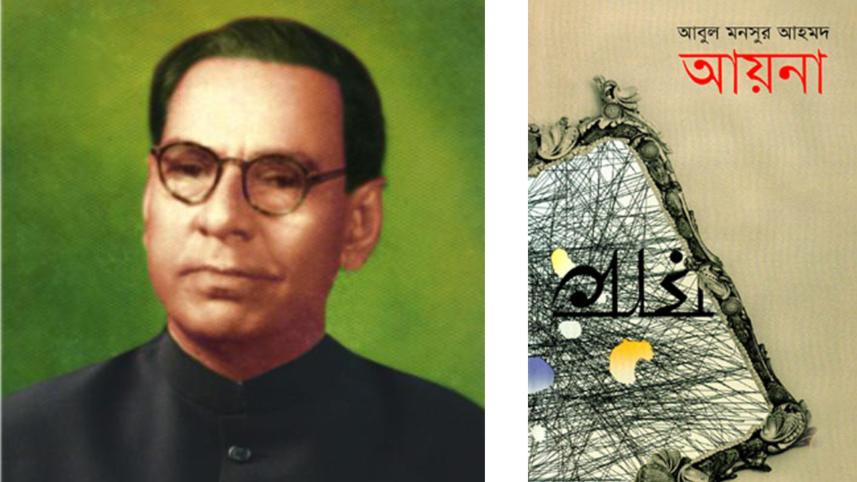
What would happen if we stood the society around us in front of a mirror? Would it show only our neat, presentable face, or would the darker sides hiding behind the mask come through too? ‘Ayna’ by the celebrated writer and politician Abul Mansur Ahmed is exactly that kind of mirror, one that puts society’s hypocrisy and blind faith on full display.
Abul Mansur Ahmed was a journalist, writer, and politician all at once. Published by Ahmad Publishing House, ‘Ayna’ is essentially a collection of satirical stories. Layer by layer, he takes aim at the religious exploitation, communalism, and hollow politics of his time. The book draws its material from the everyday contradictions the author himself witnessed in society.
Unmasking Hypocrisy
The book’s central theme is stripping away the mask of social and religious hypocrisy. It brings together seven stories: Hujur Keblah, Go-Deota Ka Desh, Nayebe Nabi, Livre-e-Qawm, Mujahedin, Bidrohi Sangha, and Dharma-Rajya. Each one captures, with remarkable precision, how a certain class of people exploits ordinary people’s simplicity in the name of religion to serve their own ends.
In ‘Hujur Keblah’, a pir hides behind the language of spirituality while scheming to marry one of his own disciple’s wife. Emdad, a young man educated in modern schooling, falls under the spell of blind faith and visits the pir, but eventually sees through the deception. In ‘Nayebe Nabi’, a power struggle between two clerics over who gets to lead a funeral prayer paints a picture that is absurd and painfully real at once. The scuffle breaking out in front of a dead body says everything about how personal ego outweighs faith for these men.
A Sharp, Vivid Pen
Abul Mansur Ahmed’s prose is clear and cutting. He blends the spoken language of his time with Arabic and Persian words so skillfully that his characters feel entirely alive. His wit and dry humor make readers laugh while forcing them to think at the same time. The metaphor he builds in ‘Go-Deota Ka Desh’, of a country drowning in a flood of cow’s milk, shows off his imagination and comic sensibility at their sharpest.
The stories are also well constructed. Each one opens with a tone of ideological or religious solemnity, which slowly crumbles as the plot unfolds, revealing the true face of the characters underneath. Characters like Ismail Shaheb in ‘Livre-e-Qawm’ feel entirely believable in the way they use a mix of religion and politics to secure their own interests. He builds himself up as a selfless leader through his newspaper ‘Ahle-Hadis-Gurjya’, while in reality he dodges accountability and looks out only for himself. The author’s deep understanding of human psychology and social structures comes through clearly in how these characters behave. In ‘Bidrohi Sangha’, the cowardice hiding behind the empty slogans of so-called revolutionaries is dissected with real precision, and the scene where they forget their ideals and scramble over a wall the moment they hear the police are coming is genuinely funny.
Where the Satire Cuts Deepest
‘Mujahedin’ shows a bloody clash between the Hanafi and Mohammadi communities over the smallest of doctrinal differences, and it points squarely at the politics of division within society. It makes clear how religious profiteers manipulate ordinary people to their own advantage. ‘Dharma-Rajya’, meanwhile, paints a chilling picture of how blind religious zealotry, over something as small as playing music in front of a mosque, drags both Hindu and Muslim communities toward ruin. The scene where people from both sides die of starvation just to hold their ground in the name of religion drives home the sheer futility of that fanaticism.
Fearless, and Still Relevant
The book’s greatest strength is its fearlessness. The author holds nothing back, striking directly at the hypocrisy buried in every corner of society. As for its limitations, some of the Arabic and Persian vocabulary and the political context of that era may feel somewhat opaque to today’s readers. In a few places, the satire also cuts sharp enough that certain sensitive readers might find it uncomfortable. Still, the core message of these stories is timeless enough that these minor issues barely dent the reading experience.
Though written long ago, ‘Ayna’ hasn’t lost an ounce of relevance. Religious exploitation, communal violence, and political hypocrisy remain just as visible in our society today. For anyone who wants to look at society from a different angle, and who enjoys sharp, intelligent satire, this book is essential reading.
‘Ayna’ isn’t just a collection of stories, it’s a merciless reflection of our collective psyche. Wrapping society’s decaying corners in humor, the author tries to wake us up to what’s really there. This precious gem of satirical literature shines in its own right within Bengali literature. Abul Mansur Ahmed’s courage and foresight have earned this book the status of a classic. As food for intelligent thought, it deserves a place in every thoughtful reader’s collection, even now.
Tanjid Shuvro